
Hey everyone! Today we’re talking about the ins and outs of commissioning plate heat exchangers. If this equipment isn’t commissioned properly, it’ll act just like a tantrum-throwing kid and give you a world of headaches. But don’t worry—we’ve got the know-how to make it run like a dream.
Just the other day, a factory had their plate heat exchanger overhauled. After an overhaul, proper commissioning is a must; how else can you ensure it operates as it should? First off, we need to check the installation. Much like building a house requires a solid foundation, a plate heat exchanger needs to be installed sturdily. Loose anchor bolts are a big no-no—they’ll make the equipment wobble like a person with weak legs walking. There’s a real case where a factory failed to tighten the anchor bolts properly, and the equipment shook violently during operation, scaring everyone half to death. So be sure to check if the anchor bolts are loose, and tighten them up right away if they are.
The connection of inlet and outlet pipelines can’t be taken lightly either. Improper connections that cause stress concentration are like putting a tight curse on the equipment—how can it run smoothly? Pipelines must be laid out rationally, without excessive bending or stress concentration. We also need to inspect the shock absorption measures between the equipment and its support structure. Without effective shock absorption pads or devices, the equipment will rumble like a drum when in operation, making the whole area buzz with vibration.
Once the installation check is passed, it’s time for cleaning and pressure testing. Imagine driving a newly repaired car without cleaning it first—it just doesn’t feel right, does it? The same goes for plate heat exchangers. After an overhaul, impurities and dirt may remain inside, so it needs to be thoroughly flushed with a suitable cleaning agent to leave the heat exchange plates spotless. Then comes pressure testing, which is like inflating a balloon to see how much pressure it can withstand. Gradually raise the pressure to 1.25 times the design pressure and hold it for a while. If there’s any leakage, find the cause and fix it immediately.
Filling the medium also requires care. Select the heat exchange medium in accordance with process requirements, then fill it slowly—just like pouring water into a cup, never rush it. You also need to bleed the air out; otherwise, air lock will compromise the heat exchange efficiency. Check the medium’s flow rate, pressure, temperature and other parameters to ensure they meet the design specifications.
When everything is ready, it’s time to start up and commission the equipment. This is just like driving a car—you have to accelerate gradually. Start the equipment slowly and increase the medium’s flow rate and pressure step by step. If abnormal vibration, noise or other issues occur, shut down the equipment and inspect it at once. Monitoring the heat exchange efficiency is also crucial; check if the temperature change of the inlet and outlet medium is as expected. If the heat exchange efficiency is poor, adjust parameters such as flow rate and pressure, or check if the heat exchange plates are clogged or scaled. Pay attention to the gaskets too: if there’s leakage, adjust the torque of the clamping bolts appropriately, but don’t over-tighten them—otherwise, the gaskets or heat exchange plates will get damaged.
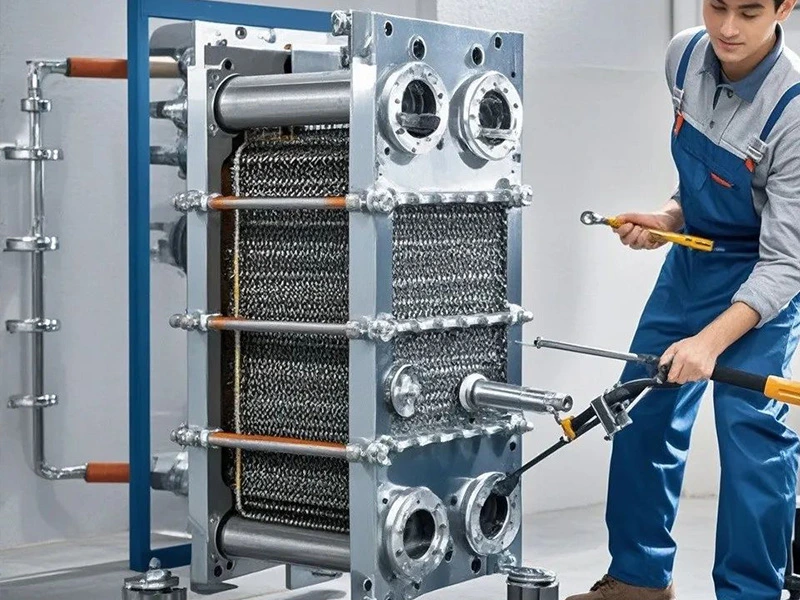
Even after the equipment is running normally, never let your guard down. Keep monitoring all operating parameters, just like a doctor doing a physical examination for a patient. Establish operation records, analyze the data regularly, and identify and address any problems in a timely manner. Conduct regular maintenance on the equipment as well, such as cleaning the heat exchange plates, replacing gaskets, and checking the tightness of bolts, to keep the equipment in optimal condition at all times.
What if abnormal vibration occurs during commissioning? Don’t panic! Let’s analyze the possible causes. Unstable installation is a common issue—loose anchor bolts, improper pipeline connections and inadequate shock absorption measures can all lead to vibration. On the medium side, excessive flow rate, overly high velocity, solid particles or impurities in the medium, or changes in the medium’s physical properties can all make the equipment vibrate violently. The equipment itself may also have problems: deformed or damaged heat exchange plates, aged or incorrectly installed gaskets, or air lock inside the equipment can all cause vibration. External interference can’t be ignored either—vibration transmission from other nearby equipment or external environmental factors can all disrupt the stable operation of the plate heat exchanger.
There are plenty of solutions to these problems. Inspect and adjust the installation: tighten anchor bolts, eliminate pipeline stress concentration, and check shock absorption measures. Optimize medium conditions: adjust flow and velocity, filter the medium, and monitor changes in physical properties. Inspect and fix equipment issues: replace damaged plates and gaskets, and eliminate air lock. Reduce external interference: keep the equipment away from high-vibration machinery or take isolation measures.
In short, commissioning a plate heat exchanger is no easy task—it requires carefulness and patience. As long as you follow the correct procedures and methods, you can ensure its stable operation and make it serve our production and daily life effectively.
 ZIBO BOAS
Room 811, 8th Floor, Block A Tianfu International Building, No.186 Xincun Road, Zhangdian District, Zibo City, Shandong Province, China
Rose Zhao

Copyright © 2025 by Zibo BOAS Industrial Technology Co.,Ltd All Rights Reserved
Privacy Policy