
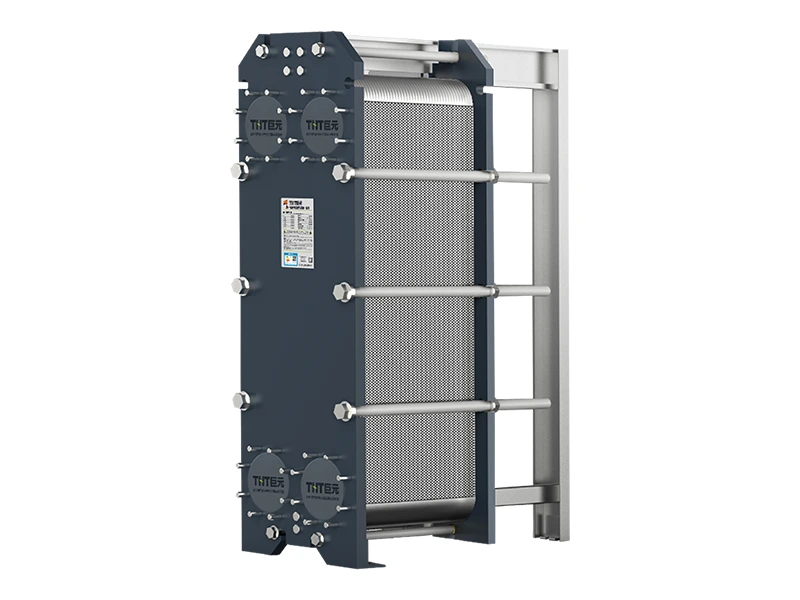
Gasket ejection and fracture are common failure types in the operation of plate heat exchangers, whose causes are mainly related to three categories of factors: the gasket's own quality, the heat exchanger assembly process, and the operating condition parameters. The specific causes are as follows:
Inherent Quality Defects of Gaskets
1.Mismatched material selection: The gasket material is not selected according to the medium characteristics (corrosivity, temperature) and pressure rating. For example, ordinary nitrile butadiene rubber (NBR) gaskets used in high-temperature or highly corrosive working conditions are prone to material aging and embrittlement, which in turn leads to cracking and ejection.
2.Production process defects: Incomplete vulcanization of the gasket, internal air bubbles or impurities, or excessive dimensional deviation of the lip on the sealing surface will cause uneven stress, resulting in local stress concentration and fracture under pressure.
3.Aging and failure: Overdue use of gaskets causes the rubber material to harden and crack, losing elasticity and sealing performance. The gaskets can no longer adapt to the thermal expansion and contraction of the heat exchanger, and eventually eject and fracture.
Improper Assembly and Maintenance of Heat Exchangers
1.Incorrect tightening sequence or inconsistent torque of clamping bolts: This leads to excessive local compression or insufficient compaction of the gasket, and the insufficiently compacted parts are prone to ejection under pressure.
2.Excessive clamping force: Directly crushing the gasket lip, causing damage to the rubber material and subsequent fracture after a period of operation.
3.Incomplete cleaning of sealing grooves: Scale from residual medium, welding slag, sundries and other debris in the sealing grooves prevent the gasket from being fully embedded in the grooves, resulting in excessively high local stress after assembly and cracking during operation.
4.Uneven or excessive clamping force
5.Deformation or damage of plates: Warpage and deformation of plates caused by temperature difference stress or foreign object impact, or burrs and scratches on the edges of sealing grooves, will damage the stress balance of the gasket and cause local cracking and ejection.
Abnormal Operating Conditions
1.Severe fluctuations in temperature and pressure: Frequent system start-stop and sudden rises and falls in medium temperature or pressure cause repeated thermal expansion and contraction of plates and gaskets, generating alternating stress between gaskets and sealing grooves, which leads to fatigue fracture under long-term action.
2.Medium impact or cavitation: Excessively high medium flow rate or gas-liquid two-phase flow inside the heat exchanger causes high-speed fluid or air bubbles to impact the gasket sealing surface, resulting in local wear and tearing, and eventual ejection.
3.Medium corrosion or swelling: Corrosive substances such as strong acids and alkalis in the medium, or chemical reactions with the gasket material, cause the gasket to swell, soften and lose strength, leading to subsequent fracture and failure.
 ZIBO BOAS
Room 811, 8th Floor, Block A Tianfu International Building, No.186 Xincun Road, Zhangdian District, Zibo City, Shandong Province, China
Rose Zhao

Copyright © 2025 by Zibo BOAS Industrial Technology Co.,Ltd All Rights Reserved
Privacy Policy